
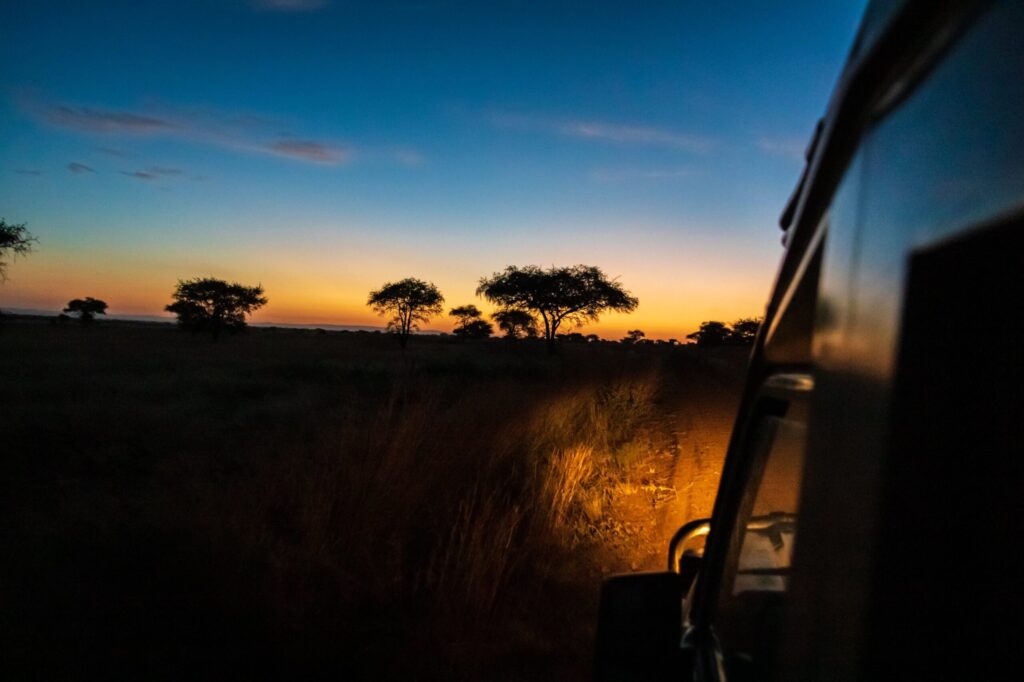
The northern circuit is famous for good reason, but it is not the whole country. If you have been to Tanzania before, or you would rather not share a leopard sighting with fifteen vehicles, the lesser-known Tanzania safari destinations below are where the country gets interesting again.
None of these are secret. They are simply harder to reach, which is exactly why they are quiet.
Nyerere National Park
Formerly part of the Selous Game Reserve, and now one of the largest protected areas in Africa. The Rufiji River runs through it, which changes the whole character of a safari: boat trips alongside hippo and crocodile, walking safaris with an armed ranger, and fly camping. Strong for wild dog, which are difficult to see on the northern circuit.
Best months: June to October. Getting there: Fly from Dar es Salaam, roughly an hour.
Ruaha National Park
Tanzania’s largest national park and, for many guides, the best big-cat park in the country. Very large lion prides, excellent leopard, and a landscape of baobabs and sand rivers that looks nothing like the Serengeti. Vehicle density is a fraction of the north.
Best months: June to October, when game concentrates on the Great Ruaha River. Getting there: Fly from Dar es Salaam or Arusha.
Katavi National Park
The remote one. Very few visitors reach it, and in the late dry season the floodplains hold extraordinary concentrations of hippo and buffalo. This is a serious expedition rather than an add-on, and it suits repeat safari-goers who want somewhere genuinely empty.
Best months: August to October. Getting there: Charter flight, and it is not cheap.
Mahale Mountains
Chimpanzee trekking on the shore of Lake Tanganyika, with forested mountains running down to a beach. Logistically demanding, expensive, and the sort of place people describe for years afterwards. There are no roads in the park, so you walk.
Best months: May to October. Getting there: Charter flight plus a boat transfer.
Mkomazi National Park
In the north-east, in the shadow of Kilimanjaro, with a black rhino sanctuary and a wild dog breeding programme. Semi-arid and quiet, and close enough to combine with the northern circuit without a major detour.
Best months: June to October. Getting there: Drive from Moshi or Arusha.
Lake Natron
Not a game park. A soda lake at the foot of Ol Doinyo Lengai, the active volcano the Maasai call the Mountain of God, with flamingo breeding grounds and a landscape that looks almost Martian. Add it for the scenery and the walk to the waterfalls rather than for wildlife.
Best months: June to October. Getting there: A rough drive north from Ngorongoro.
Empakaai and Olmoti craters
Two smaller craters inside the Ngorongoro Conservation Area that almost nobody visits. Empakaai has a soda lake with flamingos and a steep descent on foot through forest. It is the easiest way to add something genuinely quiet to a standard northern itinerary, because you are already there.
How to fit these into a trip
- First visit to Tanzania? Do the northern circuit. It is famous because it delivers. Add Empakaai or Lake Natron for a quiet day.
- Second visit? Ruaha and Nyerere together make an excellent southern circuit, with a completely different feel and a fraction of the vehicles. Our 6 day Untamed Southern Tanzania is built that way.
- Third visit, or you want remote? Katavi and Mahale, usually combined because the flight routing suits it.
Be realistic about internal flights. The southern and western parks are reached by air, and the cost of getting there is a real part of the budget. See what a Tanzania safari costs for how transfers fit into the overall figure.
Common questions
Are these parks worth the extra cost?
For a first safari, generally no. The northern circuit gives you more wildlife per shilling. For a second, the quiet is worth a great deal and the experience is genuinely different rather than simply further away.
Can I combine north and south?
Yes, though it needs internal flights and at least twelve nights to avoid spending the trip in aircraft. A common pairing is a short northern circuit followed by Ruaha.
Is the wildlife as good?
Different rather than lesser. Ruaha arguably beats the north for big cats. What you give up is the migration, which only happens in the Serengeti ecosystem.
Are these places safe?
Yes, with the same guiding and camp practice as the northern parks. They are more remote, which makes comprehensive travel insurance including medical evacuation more important rather than less.
Itineraries off the standard route
- Untamed Southern Tanzania (6 days): boat, walk and drive in Nyerere, then fly to Ruaha.
- River & Wildlife Adventure (4 days): boat, walk and game drive in Nyerere, flying in from Dar es Salaam.
- Walk With Wild Africa (5 days): ranger-led walks in Nyerere, game drives and a boat trip on the Rufiji.
Plan something off the standard route
We build southern and western itineraries as readily as northern ones, and we will tell you honestly whether a remote park suits the trip you are describing or whether your money is better spent on more days in fewer places.
See our Tanzania safari packages, read how to plan a Tanzania safari, and compare with the Serengeti and the Ngorongoro Crater.
Tell us where you have already been and we will suggest where to go next.
